Share
Product Catagory
Recent Articles
Custom Dog Bed Development: From Reference Image to Production
Dog Crate Mat Size Guide for Wholesale & Private Label Buyers
Contact Manufacturer
Foam density is the decisive factor in determining whether an orthopedic dog bed provides real long-term support or loses shape quickly. While many retail buyers focus only on bed thickness, density—measured in D or lb/ft³—matters more for durability and rebound performance. As an OEM orthopedic dog bed manufacturer supplying standard 18D to premium 50D structures, we specialize in customizing foam configurations based on customer retail price targets, dog sizes, and vacuum-packaging needs. This technical guide explains how different foam densities perform, how memory foam differs from egg-crate foam, and how density impacts your bulk shipping costs.
What Does Foam Density Mean?
Foam density refers to the weight of foam within a fixed volume.
Higher-density foam usually contains more material structure, which improves:
- long-term support
- pressure resistance
- rebound ability
- durability
- structural stability
Lower-density foam may initially feel soft, but it generally compresses faster and loses support more quickly under repeated pressure.
This is especially important for:
- large dogs
- senior dogs
- dogs with arthritis
- orthopedic dog beds designed for daily use
D vs lb/ft³ Foam Density Conversion
Asian foam factories commonly use “D” density measurements, while the US market often uses lb/ft³.
Below is a simplified comparison table:
| Density (D) | Approx lb/ft³ | Typical Use |
|---|---|---|
| 18D | ~1.1 lb/ft³ | budget foam |
| 25D | ~1.6 lb/ft³ | entry support |
| 32D | ~2.0 lb/ft³ | standard orthopedic |
| 35D | ~2.2 lb/ft³ | premium orthopedic |
| 40D | ~2.5 lb/ft³ | high-support orthopedic |
| 45D | ~2.8 lb/ft³ | specialty support |
| 50D | ~3.1 lb/ft³ | high-end orthopedic support |
In the orthopedic dog bed industry, 32D and 35D memory foam are currently the most common configurations because they balance:
- support
- comfort
- production cost
- shipping weight
- compression packaging performance
Higher densities such as 40D, 45D, and 50D are usually reserved for special customization projects or premium orthopedic collections.
Common Foam Densities Used in Orthopedic Dog Beds
18D Regular Foam
18D foam is typically used in low-cost pet beds.
Advantages:
- lower cost
- lighter weight
- easier shipping
Limitations:
- compresses quickly
- weak orthopedic support
- shorter lifespan
This density is usually unsuitable for large orthopedic dog beds or senior dog products.
25D Compressible Foam
25D foam is commonly used for compressible dog beds and entry-level support structures.
Advantages:
- better compression performance
- affordable cost
- suitable for vacuum packaging
Limitations:
- moderate support only
- faster flattening under heavy dogs
Most vacuum-compressed orthopedic dog beds require at least 25D foam to maintain structural stability during shipping.
25D Egg-Crate Foam
Egg-crate foam uses a wave-shaped structure that improves airflow while reducing material weight.
Advantages:
- breathable structure
- lower shipping weight
- easier compression packaging
- lower cost
Limitations:
- lower support than memory foam
- shorter rebound lifespan
- less suitable for giant breeds
Egg-crate foam is commonly used in:
- mid-range orthopedic dog beds
- breathable support layers
- combination foam structures
Memory Foam Density: 32D to 50D
Memory foam is widely used in orthopedic dog beds because it conforms to the dog’s body and distributes pressure more evenly.
We commonly produce memory foam orthopedic dog beds using:
- 32D memory foam
- 35D memory foam
- 40D memory foam
- 45D memory foam
- 50D memory foam
Among these, 32D and 35D are the most widely used for commercial orthopedic dog beds.
32D Memory Foam
32D memory foam is one of the most balanced orthopedic pet bed foam options.
Advantages:
- good support
- comfortable rebound
- moderate cost
- suitable for daily orthopedic use
This density is commonly used in:
- Amazon orthopedic dog beds
- private label orthopedic collections
- medium and large dog beds
35D Memory Foam
35D memory foam provides stronger support and longer rebound retention for dog beds.
Advantages:
- better durability
- improved pressure relief
- stronger support for larger dogs
This density is often used in:
- premium orthopedic dog beds
- higher retail price products
- senior dog collections
40D–50D Memory Foam
40D, 45D, and 50D memory foam are considered premium pet beds orthopedic support materials.
Advantages:
- stronger pressure distribution
- higher structural stability
- longer lifespan
- better support for large dogs
Limitations:
- significantly higher material cost
- increased shipping weight
- slower rebound after compression
- higher retail pricing
These densities are usually used for:
- giant breed orthopedic dog beds
- senior dogs with severe joint problems
- luxury orthopedic collections
Density Matters More Than Thickness
One common misconception is:
“A thicker dog bed automatically means better orthopedic support.”
In reality, density and structure matter more.
A thick bed using low-density foam may still flatten quickly.
Orthopedic support depends on the combination of:
- density
- thickness
- structural layering
- weight distribution
Most orthopedic dog beds use foam thicknesses between 5cm and 10cm depending on the dog’s size and support requirements.
Example Orthopedic Foam Structure
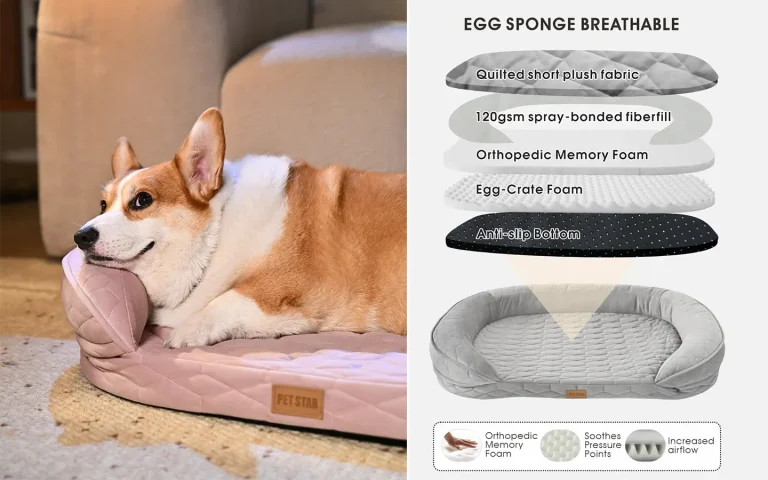
One typical orthopedic construction may include:
| Layer | Function |
|---|---|
| Quilted short plush fabric | surface comfort |
| 120gsm spray-bonded fiber | cushioning |
| 32D orthopedic memory foam | pressure relief |
| 18D egg-crate foam | airflow support |
| anti-slip bottom | stability |
Different retailers choose different structures depending on:
- target retail price
- shipping requirements
- dog size
- climate conditions
Air Fiber Orthopedic Support Dog Beds
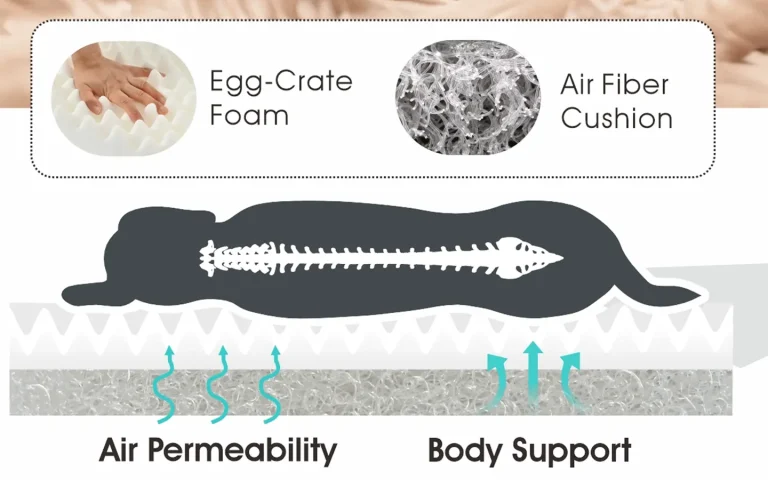
Air Fiber is becoming increasingly popular in orthopedic pet beds.
Unlike traditional foam, Air Fiber uses a breathable open support structure.
Common thicknesses include:
- 5cm standard
- 3cm custom
- 8cm premium custom
Air Fiber can also be combined with:
- memory foam
- support foam
- cooling layers
Advantages include:
- dries quickly
- does not absorb urine
- easier cleaning
- improved airflow
- strong support structure
This makes Air Fiber especially suitable for:
- senior dogs
- washable orthopedic beds
- humid environments
- cooling pet bed
Why Low-Density Foam Flattens Faster
One of the biggest complaints in orthopedic dog beds is flattening.
Common causes include:
- low-density foam
- shredded foam filling
- insufficient thickness
- concentrated sleeping pressure
- oversized dogs using undersized beds
- moisture entering the foam structure
Moisture is often underestimated.For example, dogs returning from rainy outdoor environments may introduce moisture into the foam core, which can gradually reduce support performance over time.reduce support performance over time. To combat this risk, understanding the fabric science behind the best waterproof dog bed configurations is essential for brand owners.
Solid Memory Foam vs Shredded Memory Foam
Orthopedic dog beds may use either:
- solid slab memory foam
- shredded memory foam filling
Solid memory foam generally provides:
- more stable support
- better pressure distribution
- longer structural lifespan
Shredded memory foam usually offers:
- softer feel
- lower cost
- easier shaping
However, shredded structures may shift over time and provide less consistent orthopedic support.
Most premium orthopedic dog beds use solid memory foam cores.
Compression Packaging and Foam Rebound
Compression packaging is extremely important for orthopedic dog bed shipping.
As a professional OEM dog bed manufacturer, we provide:
- vacuum packaging
- roll packing
- compression packaging for Amazon FBA
However, compression packaging affects rebound performance.
Most orthopedic dog beds require:
- approximately 24 hours to fully rebound after unpacking
Higher-density foam generally rebounds better, while thicker foam structures may require more recovery time.
You can also read our guide on:
“Reducing Shipping Costs for Wholesale Large Dog Beds”
Foam Density and Retail Market Preferences
Different retail markets prefer different foam structures.
| Market Type | Preferred Foam |
|---|---|
| Amazon sellers | memory foam |
| wholesale chains | egg-crate foam |
| supermarkets | polyester filling |
| premium pet brands | egg-crate + memory foam combinations |
| senior dog collections | Air Fiber systems |
Amazon sellers especially prefer memory foam orthopedic dog beds because compression packaging and custom branding work well for e-commerce fulfillment.
Final Thoughts
Foam density is one of the most important factors affecting orthopedic dog bed performance.
Higher-density foam generally provides:
- stronger support
- better durability
- longer rebound lifespan
- improved orthopedic performance
However, density must also be balanced with:
- shipping cost
- compression performance
- product positioning
- retailer budget
For OEM orthopedic dog bed buyers, understanding the differences between 18D, 25D, 32D, 40D, and 50D foam structures is essential when selecting the right product configuration.
FAQ:
32D to 35D memory foam is commonly used for orthopedic dog beds because it balances support, comfort, and durability.
50D memory foam offers premium durability and pressure relief, but it significantly increases production costs and shipping weight. As an experienced pet bed factory, we usually recommend 50D for luxury flagship collections or specialized senior dog lines, while 32D/35D works best for mass-market scaling.
Not always. High thickness with low density (like 18D) results in quick flattening and high customer return rates for retailers. For cost-effective pet bed procurement, a smart layered structure (e.g., 5cm 32D memory foam bonded with a support layer) performs better, lasts longer, and survives vacuum roll-packing without losing shape.
Product flattening is the #1 cause of negative reviews on Amazon, but utilizing reliable, standard-compliant foam significantly reduces this risk. As the largest pet bed factory in China, our company has established a comprehensive quality management system over the past 20+ years, ensuring every batch of raw material undergoes strict incoming inspection. Protecting your brand reputation with verified, factory-tested materials.
It depends on your market positioning and product differentiation goals. Air Fiber is ideal for premium, 100% washable, and anti-allergy senior dog beds. Memory foam dominates the mainstream orthopedic market. As a flexible dog bed manufacturer, we often combine both materials in custom product development to help buyers capture multiple retail price tiers.
Related Blogs
You Might Also Like