Was macht ein Hundebett wirklich orthopädisch? Erläuterungen zu Schaumstoffdichte, Stützkraft und Herstellung
- Oscar
Teilen
Produkt Kategorie
Aktuelle Artikel
Custom Dog Bed Development: From Reference Image to Production
Dog Crate Mat Size Guide for Wholesale & Private Label Buyers
Kontakt Hersteller

Not every bed labeled “orthopedic” actually provides orthopedic support.
In today’s pet market, many dog beds use soft low-density foam, thin padding, or shredded filling while still being marketed as orthopedic dog beds. These products may feel soft at first, but they often flatten quickly and fail to support larger dogs or senior dogs over time.
A truly orthopedic dog bed is designed to provide long-term support, pressure relief, and structural stability. The quality of the foam, density, thickness, construction, and airflow system all matter.
As an OEM orthopedic dog bed manufacturer, we work with multiple foam structures including memory foam, gel memory foam, egg-crate foam, and Air Fiber support systems. Different combinations are used based on the dog’s weight, sleeping habits, climate, and retailer budget.
What Is an Orthopedic Dog Bed?
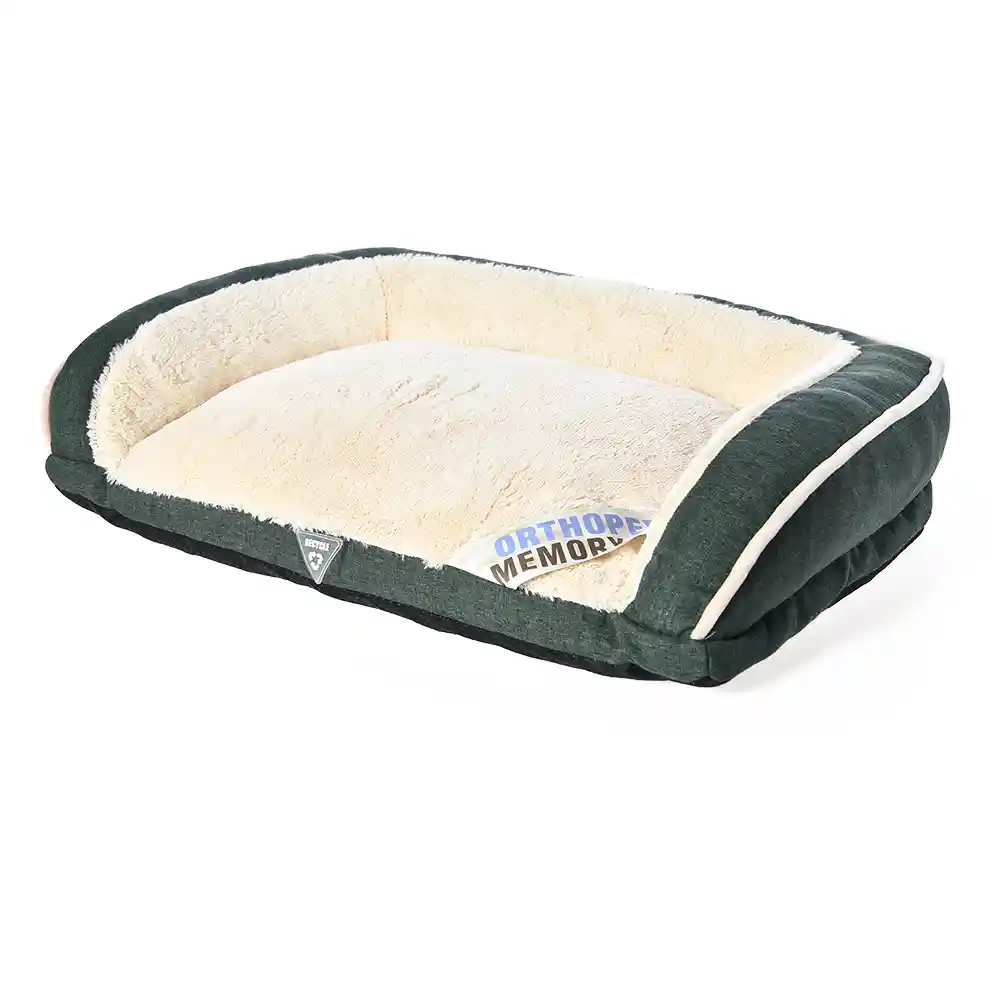
Ein orthopädische Hund Bett is designed to reduce pressure on a dog’s joints, hips, spine, and muscles while maintaining stable body support during long periods of rest.
Unlike standard polyfill beds that compress easily, orthopedic dog beds typically use supportive foam cores and layered construction to help distribute body weight evenly.
Orthopedic beds are especially popular for:
- ältere Hunde
- large breed dogs
- Hunde mit Arthritis
- dogs with hip dysplasia
- dogs recovering from surgery
- dogs that sleep for long hours
However, not all memory foam beds are truly orthopedic. Foam density, thickness, and structure matter more than marketing terms alone.
What Makes a Dog Bed Truly Orthopedic?
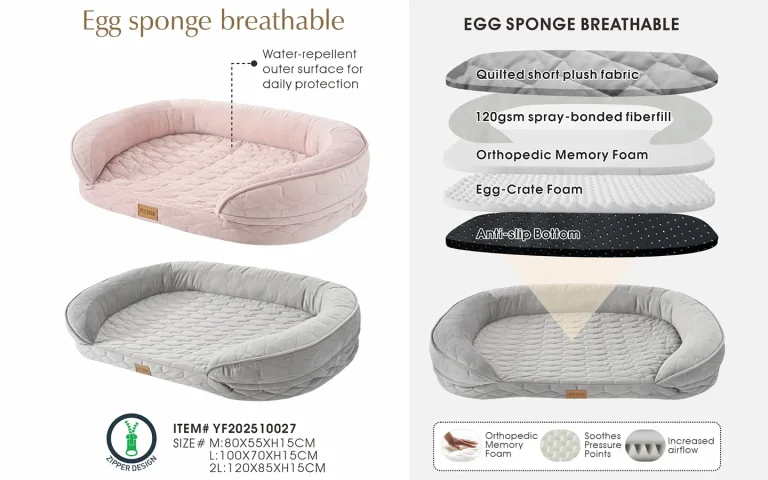
A truly orthopedic dog bed usually includes:
- supportive high-density foam core
- pressure-relieving comfort layers
- sufficient thickness for weight support
- durable long-term rebound ability
- stable bottom construction
- breathable or cooling structure
- anti-slip bottom for stability
The internal construction is far more important than simply making the bed feel soft.
For example, one common orthopedic structure may include:
| Ebene | Funktion |
|---|---|
| Gesteppter, kurzfloriger Plüschstoff | Liegekomfort |
| 120 g/m² spritzgebundene Faser | soft cushioning |
| Orthopedic memory foam | Druckentlastung |
| Egg-crate foam | airflow and support |
| Anti-slip bottom | Stabilität |
Different foam combinations are used depending on the target market, dog size, and retailer budget.
Foam Density Is One of the Most Important Factors
Foam density directly affects:
- support performance
- Langlebigkeit
- Rückprallfähigkeit
- long-term shape retention
Low-density foam usually feels soft initially but loses support faster.
Higher-density orthopedic foam provides stronger support and maintains structure longer, especially for large dogs and senior dogs.
Foam Density Comparison
| Dichte (D) | ca. lb/ft³ | Typische Anwendung |
|---|---|---|
| 18D | ~0,06 kg/m³ | preisgünstiger Schaumstoff |
| 25D | ~0,45 kg/m³ | entry-level support |
| 32D | ~0,56 kg/m³ | standard orthopedic support |
| 40D | ~2,5 lb/ft³ | premium support |
| 50D | ~1,4 kg/m³ | hochwertige orthopädische Stütze |
Many low-cost orthopedic dog beds use low-density foam or even shredded foam scraps, which flatten much faster under repeated pressure.
Common Foam Types Used in Orthopedic Dog Beds
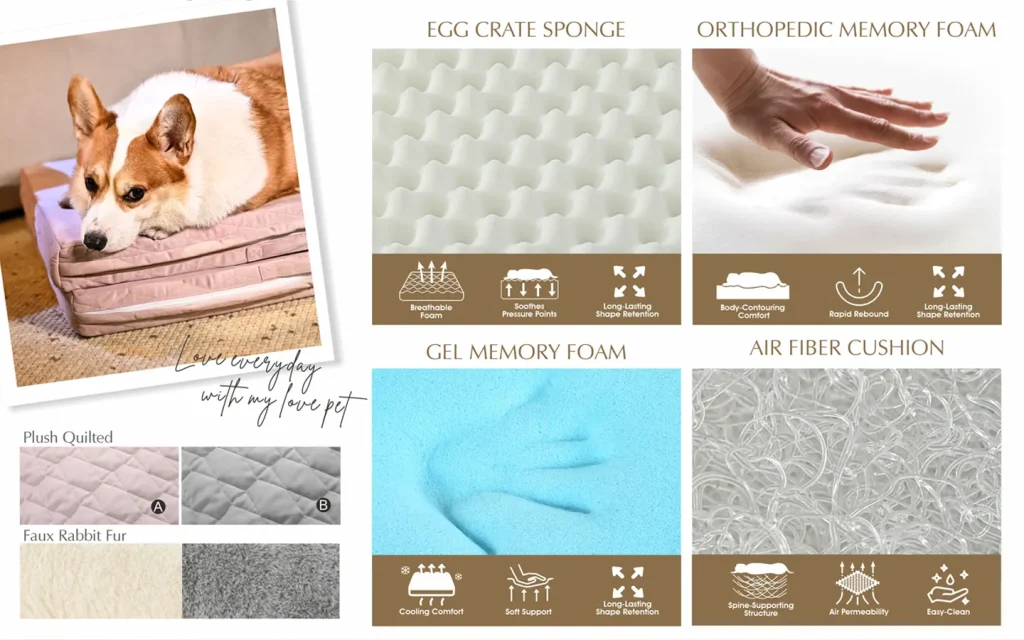
Memory-Schaum
Memory foam is widely used in premium orthopedic dog beds because it conforms to the dog’s body and helps reduce pressure points.
Vorteile:
- strong pressure relief
- comfortable support
- suitable for senior dogs
- better long-term rebound
Challenges:
- retains more heat
- heavier shipping weight
- higher production cost
- slower rebound after vacuum compression
We commonly use memory foam densities from 32D to 50D depending on the project requirements.
Eierkuchen-Schaum
Egg-crate foam uses a wave-shaped surface structure that improves airflow while reducing material cost.
Vorteile:
- more breathable
- geringeres Gewicht
- geringere Kosten
- einfachere Kompressionsverpackung
Challenges:
- weniger Stützkraft als Memory-Schaum
- flattens faster over time
- weniger geeignet für große Hunderassen
Typical density used:
- 25D-Waben-Schaumstoff
Egg-crate foam is commonly used in mid-range orthopedic dog beds or as a secondary support layer.
Gel-Memory-Schaum
Gel memory foam combines memory foam with cooling gel technology.
Vorteile:
- improved cooling performance
- Druckentlastung
- premium positioning
Challenges:
- higher material cost
- heavier structure
- more complex manufacturing
Many retailers combine gel memory foam with cooling fabrics for summer orthopedic dog beds.
Air Fiber Support System
Air Fiber is becoming increasingly popular in orthopedic pet beds, especially for senior dogs and washable pet products.
Unlike traditional foam, Air Fiber has a highly breathable open structure.
Vorteile:
- trocknet schnell
- nimmt keinen Urin auf
- easier to clean
- better airflow
- stronger support structure
- suitable for senior dogs
Air Fiber is especially useful for dogs with waterproof or hygiene needs.
Why Some Orthopedic Dog Beds Lose Support Quickly
One of the biggest complaints from pet owners is:
“My orthopedic dog bed flattened too fast.”
This usually happens because of structural or material limitations.
Zu den häufigsten Ursachen gehören:
- Schaumstoff mit geringer Dichte
- Füllung aus Schaumstoffschnitzeln
- unzureichende Dicke
- große Hunde, die zu kleine Betten benutzen
- weak edge support
- concentrated pressure in one sleeping area
- moisture entering the foam core
Moisture is often overlooked.
For example, dogs returning from rainy outdoor conditions may bring water into the bed. Over time, increased moisture content can reduce foam performance and accelerate deformation.
While low-quality products flatten within months, real joint protection depends heavily on material mass per volume. For a complete technical breakdown, read our 18D vs 32D vs 50D memory foam explained report.
Thickness Matters — But Density Matters More
Some buyers assume thicker beds automatically provide better support.
That is not always true.
A thick bed using low-density foam may still collapse quickly under heavy dogs.
Orthopedic support depends on both:
- foam density
- structural thickness
Most orthopedic dog beds use foam thicknesses between 5cm and 10cm depending on:
- Hunde-Größe
- body weight
- sleeping habits
- Einzelhandelsbudget
As a professional orthopedic dog bed manufacturer, we often customize foam combinations based on different use cases.
Dog Size and Support Matching
Orthopedic support should match the dog’s size and weight.
Typical size recommendations include:
| Dog Weight | Recommended Size | Suitable For |
|---|---|---|
| 2–5kg | SMALL | miniature dogs, small dogs, small cats |
| 5–10kg | MEDIUM | small to medium dogs |
| 10–25kg | LARGE | medium and large dogs |
Larger dogs generally require:
- higher-density foam
- thicker support layers
- stronger zipper structures
- reinforced sidewalls
Cooling Performance Is Not Only About Foam
Many consumers believe cooling performance depends only on gel memory foam.
In reality, cooling performance is influenced by multiple factors including:
- surface fabric
- airflow structure
- foam density
- filling material
- room temperature
For example:
- memory foam traps more heat
- egg-crate foam improves airflow
- Air Fiber increases breathability
- cool-tech fabrics improve surface cooling
This is why the best cooling dog beds on the market combine:
- kühlendes Gewebe
- gel memory foam
- atmungsaktive Stützschichten
instead of relying on a single cooling component.
Manufacturing Insights From an Orthopedic Dog Bed Factory
As an OEM dog bed manufacturer, we often help customers balance:
- Komfort
- Unterstützung
- Versandkosten
- packaging size
- retail price targets
Some common industry realities include:
Oversized Beds Increase Shipping Costs Dramatically
Larger orthopedic dog beds require:
- more foam
- heavier cartons
- stronger zippers
- higher freight costs
This is why many retailers use vacuum-compressed packaging.
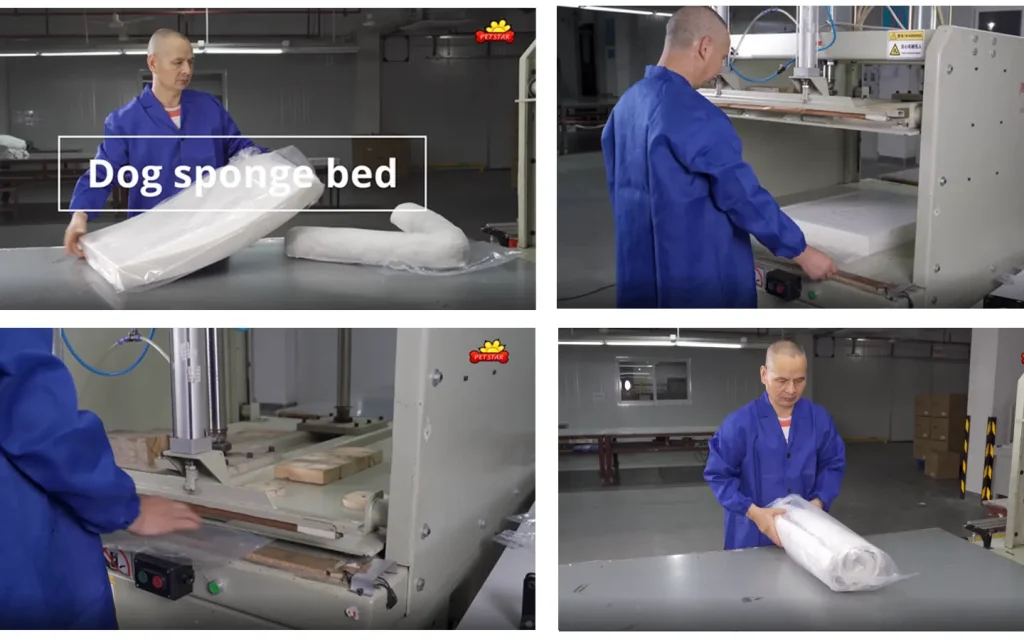
Vacuum Compression Requires Rebound Time
Compressed orthopedic dog beds usually require:
- 24–48 hours rebound time after unpacking
Higher-density foam generally rebounds better, but thicker foam may take longer to fully expand.
Different Markets Prefer Different Foam Structures
Typical market preferences include:
| Market | Preferred Structure |
|---|---|
| Amazon premium sellers | Rückstellschaum |
| budget retailers | Waben-Schaumstoff |
| senior dog products | Air Fiber |
| summer collections | gel memory foam |
Abschließende Überlegungen
A truly orthopedic dog bed is not defined by marketing labels alone.
Real orthopedic support depends on:
- foam density
- support structure
- Druckentlastung
- Dicke
- Langlebigkeit
- airflow design
- long-term rebound ability
Low-density foam and low-cost filling materials may reduce production cost, but they often fail to provide lasting support.
For retailers, importers, and private label buyers, understanding the differences between memory foam, egg-crate foam, gel foam, and Air Fiber systems is essential when selecting the right Hersteller von Haustierbetten (OEM) for your next bulk order
FAQ:
Higher-density foam generally provides better support and durability. Memory foam densities from 32D to 50D are commonly used in orthopedic dog beds.
No. Foam density, thickness, and support structure matter more than memory foam alone.
Low-density foam, insufficient thickness, concentrated pressure, and moisture exposure can all accelerate flattening.
Egg-crate foam improves airflow and reduces cost, but it usually provides less support than high-density memory foam.
Air Fiber is a breathable support material that dries quickly, resists moisture absorption, and provides strong airflow and support for senior dogs.
Verwandte Blogs
- Bestes wasserdichtes Hundebett: Die Wahrheit über Stoffwissenschaft und Beschaffung
- Wie man eine zuverlässige Hundebettfabrik für OEM/ODM-Bestellungen auswählt
- Beste Hundebetten für den Wiederverkauf im Jahr 2026 (Leitfaden für margenstarke Großhändler)
- Die besten Memory Foam Pet Beds: Top 5 Picks für ultimativen Komfort
Sie Können Auch Gerne